Is laser skin rejuvenation safe?
Yes. Laser skin rejuvenation is safe provided that the practitioner is experienced and skilled with the laser.
What’s the difference between ablative and non-ablative lasers
Ablative lasers basically scorch away the surface layers of the skin. Many ablative lasers are carbon dioxide (CO2) lasers – very effective, but pretty drastic as treatments go and depending on the intensity of the treatment, you may need a lot of recovery time after treatment. You might wonder what the point of ablative lasers is, given that there are other lasers that can improve the skin in less aggressive ways, but practitioners who like them point out that the deeper a treatment goes, the greater results it can give – as long as the patient is up for some lengthy downtime.
Non-ablative lasers heat up the lower layers of the skin to kick-start the production of new collagen – without destroying the surface of the skin. Non-ablative laser treatment may still mean four days of downtime, and you’ll need more than one treatment to get the best results.
What is a fractional laser?
Laser resurfacing has evolved over many years. The first such devices were CO2 lasers, which were used to fully remove the surface of the skin. While these were very effective, the considerable downtime, lasting several weeks, along with troublesome side effects such as permanent pigmentation change, meant that they were never acceptable for the general population of patients.
Fractional lasers, as the name suggests, only treat a fraction of the skin, leaving areas of untreated skin intact. This allows for much quicker healing times, while still having a significant effect on the skin. Depending on what the practitioner is treating, only a tiny fraction may be treated, such as with scars. In the case of resurfacing the top layer of the skin, a larger fraction will be treated.
As with all fields of medicine, laser resurfacing continues to evolve and there has been a resurgence in popularity of ‘full field’ ablation, particularly with erbium lasers. For patients seeking very profound improvement in wrinkles, this remains the most effective option. It just isn’t for the faint hearted and requires careful planning!
Does laser skin rejuvenation work?
Yes. Laser skin rejuvenation is a reliably effective treatment as long as you are in the right hands.
Does laser skin rejuvenation hurt?
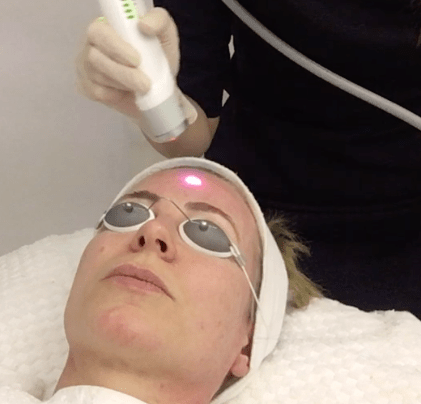
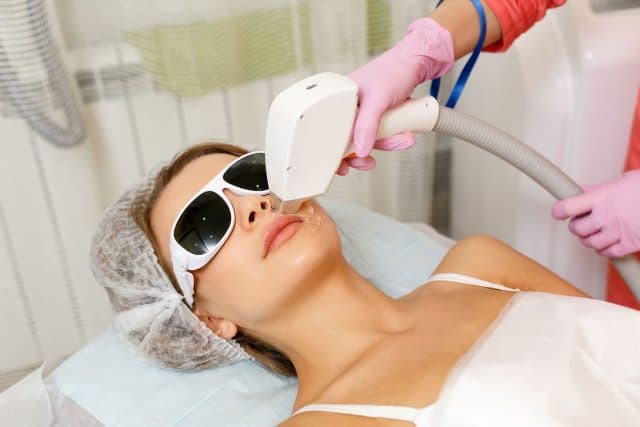
Whether laser skin rejuvenation hurts depends on exactly which treatment you have and how sensitive you are to pain. Some laser treatments make the area being treated feel hot, but not uncomfortably so. In other treatments, the laser feels somewhat like having a rubber band pinged against your skin.
Normally, the clinic will offer to apply an anaesthetic cream to the treatment area if the laser is likely to cause you discomfort.
What are pico lasers and what are they good for?
Pico lasers are relative newcomers and their pulses of energy are so quick that each lasts only a trillionth of a second – which is a picosecond, hence the name. Those energy pulses create sound waves as the laser energy is absorbed into the skin, rather than heat (it’s called a ‘photo-acoustic’ effect) and why that’s interesting is because those sound waves can safely treat sun damage in darker skins without causing hyper-pigmentation or hypo-pigmentation.
Pico lasers also shatter pigment more finely than other lasers, so they’re brilliant for tattoo removal. Here’s an analogy: if you think of a pigment molecule as a rock, and a normal pigment-busting laser shatters that rock into pieces of gravel, a pico laser will turn that pigment into sand.
Can laser be used to treat uneven pigmentation in darker skin tones?
Yes. The answer used to be ‘No’, because the potential for complications like hyper- or hypopigmentation was just too high, but with the arrival of pico lasers, it is now much easier to treat pigmentation successfully in darker skin tones. Most doctors will still medically manage conditions such as melasma first though. Hydroquinone, remains the first line treatment, with lasers being an adjunct. Uneven pigmentation is also a recurrent condition and sadly is not completely curable.
Can lasers help acne scarring?
Yes, laser treatment is great for improving the appearance of acne scarring, by resurfacing the skin and encouraging the creation of new, smoother skin. This can be done with ablative lasers, or fractional ablative lasers (hardcore, but great results), or non-ablative lasers (less tough; possibly lesser results), so discuss carefully with your chosen practitioner how much of an improvement the laser treatment that they are offering is likely to achieve.
Can lasers help acne?
Most lasers help acne scarring rather than active acne, but a new type of laser has been developed that works by targeting the sebaceous glands in the skin. The AviClear from Cutera works by reducing the activity of those oil-producing glands and it is FDA cleared for mild to severe acne – in clinical trials it has been shown to be as effective as the pharmaceutical acne treatment, Roaccutane. The laser launched in the USA in 2022 and will be launched in the UK in 2023.
How red will my skin be after laser skin treatment?
Your skin is likely to be redder if you have a stronger treatment, and that redness may last for a few hours, a few days or a few weeks as your skin heals.
How long is the downtime after laser treatment?
How long you need in ‘social downtime’ after treatment with a laser completely depends on the intensity and the extent of the treatment. If you have a light ‘pass’ of laser energy during a laser facial, you will hardly know it; if you have a more heavy-duty treatment, your face may be red for days, or weeks.
Does laser skin treatment hurt?
That all depends on the intensity of the treatment, and the strategies that practitioners can take to reduce the discomfort. A zap of laser can feel like a lightweight prickling sensation or a very sharp nip, and you will usually be given a dose of numbing cream before treatment. Many newer lasers have sophisticated cooling devices built in so that they chill the skin to reduce the sensation of heat during the treatment. What that adds up to is that treatment is not exactly pleasant, but it’s not too bad either.
What is the best time of year for laser skin treatment?
It’s best to have laser treatment during the winter because any laser treatment leaves the skin more sensitive to UV light and more susceptible to damage. It’s much easier to minimise your exposure to UV light during the winter.

 TWEAKMENT





 The Tweakments Chatbot